45 chemical and physical changes lab
PHYSICAL AND CHEMICAL CHANGES LAB Grinding, melting, dissolving, and evaporating are all physical changes. No new substance or substances are formed as a result of a physical change. A chemical change results in the formation of one or more "new" substances. These new substances differ in chemical properties and composition from the original substance. PDF Physical and Chemical Changes - Mr. Powell Science Objective 2: Observe and evaluate evidence of chemical and physical change. a. Identify observable evidence of a physical change (e.g., change in shape, size, phase). b. Identify observable evidence of a chemical change (e.g., color change, heat or light given off, change in odor, gas given off). Intended Learning Outcomes (ILOs) 1.
PDF Physical and Chemical Changes Lab - images.pcmac.org Physical and Chemical Changes Lab Purpose To study the difference between physical and chemical changes in matter. Introduction Chemistry is the study of matter and the changes it undergoes. These changes can be broken into two classes - physical changes and chemical changes. In some cases only the temperature, physical state, size

Chemical and physical changes lab
Physical and Chemical Changes home lab copy.docx ... Physical and Chemical Changes Safety rules: Please wear goggles while doing the experiments below. Ingredients required for the experiments: Vinegar Baking soda Egg Cabbage juice Can of soda Copper pennies salt Procedure : Part I Opening a can of soda. Soda is a mixture of water and carbon dioxide. Open a can of soda and leave it open to the air. Write down your observation. Chemical and Physical Change Lab Activity - iTeachly.com Physical changes usually involve a change to a substances state of matter where heat energy is added or removed. The molecular structure of the substance remains the same. For this reason, physical changes can be reversed. Chemical changes, by contrast occur at the molecular level when two or more molecules are interacting. Chemical and Physical Changes Lab ⋆ iTeachly.com 3-1 Chemical and Physical Change - Lab Answers (Doc) Background Theory: Physical changes usually involve a compounds state of matter where heat energy is added or removed. For this reason, physical changes can be reversed. By contrast, chemical changes occur at the molecular level when two or more molecules are interacting.
Chemical and physical changes lab. PDF Physical and Chemical Changes - Science4Inquiry G. Kitts, A. Cuellar, M. Aquino Printed on 1/25/17 Physical and Chemical Changes page 5 NOTE: This demonstration should be conducted by the teacher due to the concentration of the hydrogen peroxide. Wear rubber gloves to protect against burns caused by concentrated hydrogen peroxide. Physical and Chemical Changes Chemistry Lab Report | Bartleby Physical and Chemical Changes Chemistry Lab Report. The main objective of this experiment is to differentiate between a physical change and a chemical change. A physical change includes a change in the material without affecting its composition, such as the physical state change. However, a chemical change includes the change in the composition ... PDF Lab Handout Lab 2. Chemical and Physical Changes melts (see Figure L2.1). Scientists classify changes in matter as either a chemical change or a physical change. A chemical change is defined as a change in the composition and properties of a substance. Chemical changes involve the rearrangement of molecules or atoms and result in the pro-duction of one or more new substances. A physical change DOC Physical and Chemical Change Experiments A physical change involves a change in physical properties. Physical properties can be observed without changing the type of matter. Examples of physical properties include: texture, shape, size, color, odor, volume, mass, weight, pH and density. Chemical changes are changes substances undergo when they become new or different substances.
Exploring Chemical and Physical Changes Lab Sheets.docx ... Physical Only the texture changed, and the appearance which indicates a physical change. 4A White Softer white color because of the melted wax Some of the wax on top near the wick, melted and turned into wax. Chemical and Physical When melting, the wax goes from a solid to a liquid which explains the physical change. PDF PHYSICAL AND CHEMICAL PROPERTIES LAB - Weebly Which parts of this lab showed physical properties and which parts showed chemical properties? 2. State in your own words the difference between chemical and physical changes. For steps 5-12, tell if the changes where chemical or physical and explain why. 3. State in your own words the law of conservation of mass. Exploring Chemical and Physical Changes Lab Report 3.docx ... Chemical Synthetic change happened in light of the fact that gas was shaped between two fluids when they were joined which made the air pockets 2 Water- Clear Polyacryl ate- White Cloud y white and turned solid Water- 17.5 Both- 18.8 When the water was included it turned relatively thick while embeddings the thermometer. DOC Chemical and Physical Changes Lab - chsd.us To determine whether certain changes in matter are chemical or physical, and to describe the changes in detail using observational skills. Procedure: Change 1: Fill a test tube about ½ full of water, and place it in the test tube rack. Add a small scoop of sodium bicarbonate (baking soda) to the test tube.
PDF Chemical & Physical Changes Virtual Lab activity 1) Is evaporation of water a physical change or chemical change? Explain your answer. 2) List three clues that indicate that a chemical change has taken place. 3) Give several examples of chemical changes that you encounter every day. At least 3. 4) Explain how a burning candle can demonstrate both a physical and chemical change. Labs-Physical-or-Chemical-Change.pdf In the simplest sense, a physical change is a change in the form of the original substance. A chemical change is a change in the composition of the original ...4 pages Changes in Matter: Physical vs. Chemical Changes ... Remember that a physical change is a change in properties such as texture, shape, or state, while a chemical change represents the formation of a new substance after atoms are rearranged in a chemical reaction. The process of rusting, or oxidization, exemplifies a chemical reaction. PDF Physical and Chemical Changes Laboratory Purpose Background NAME_____ Physical and Chemical Changes Laboratory Purpose: To identify chemical and physical changes in matter. Background: When a substance undergoes a chemical change, a new substance is produced.The new substance will have a different composition and also different properties than the original substance.
PPT - Physical and Chemical Changes PowerPoint ...
DOC PHYSICAL AND CHEMICAL CHANGES LAB - Livingston Public Schools Grinding, melting, dissolving, and evaporating are all physical changes. No new substance or substances are formed as a result of a physical change. A chemical change results in the formation of one or more "new" substances. These new substances differ in chemical properties and composition from the original substance.

Physical vs. Chemical Change Lab
Physical and Chemical Changes Lab by Teaching Muse | TpT Learning chemical and physical changes always seems to confuse some of my students. This will definitely help them! Your activities are always so great! This is a great bundle of lab activities on chemical and physical changes! These activities look like they will be a lot of fun. I can't wait to try them out!

Lab 1: Exploring Chemical & Physical Changes - YouTube
DOC Physical & Chemical Change Lab - The Science Queen When a physical change occurs, only the form of the substance changes. Chemical changes, however, result in the formation of new substances with different properties. Some general signs of a chemical change include a change of color or odor, the formation of a precipitate (solid), the formation of a gas, and a change in heat or light.
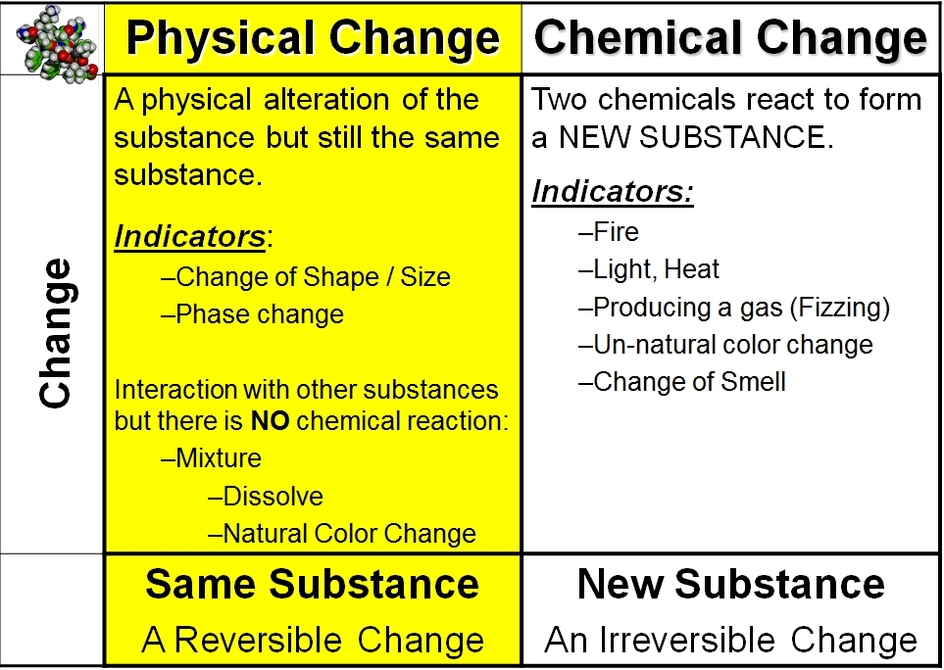
Chemical & Physical Changes - VISTA HEIGHTS 8TH GRADE SCIENCE
Chemical Changes - Experiment - Bellevue College Observe physical changes as evidence that chemical changes have taken place. ... To perform this laboratory you do not need any prior chemical experience.7 pages
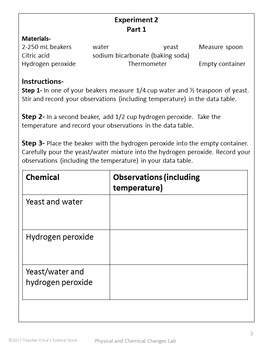
Physical and Chemical Changes Lab by Teacher Erica's ...
PDF Chemical Change Lab Chemical Change Lab Objectives: • To make scientific observations. • To observe endothermic and exothermic changes. • To observe chemical and physical changes. • To observe change in indicators based on pH levels. Materials: • Ziploc bag • Calcium chloride (CaCl 2) • Plastic spoons • Acid base indicator • Sodium bicarbonate ...

Chemical and Physical Changes, Lab Stations - YouTube
PDF General Chemistry I (FC, 09 - 10) Lab # 6: Physical and ... Lab # 6: Physical and Chemical Changes 1 One of the basic areas of interest for chemists is the study of the regrouping of atoms to form new substances. In order to determine if such a chemical change has occurred, there should be a change in the properties of the reactants that can be observed. The reaction, for example, of
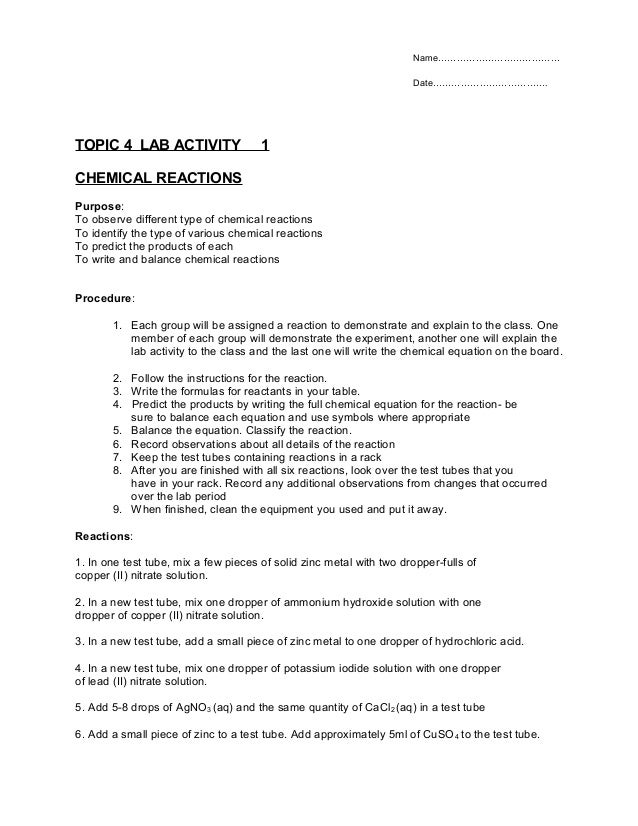
TOPIC 4. CHEMICAL REACTIONS -LAB
PDF Physical and Chemical Changes Packet Physical Change Chemical Change Explanation 1. ice melting This is a physical change because H 2 O is changing from a solid state to a liquid state. The H 2 O molecule remains the same, just in a di erent state of matter. 2. cutting a pineapple into pieces This is a physical change. The molecules that make up the pineapple are not being

Class 7 Science worksheet with detail solutions for ...
Physical And Chemical Changes Lab Teaching Resources | TpT Physical and Chemical Changes Lab by Teaching Muse 44 $4.00 Zip Reinforce characteristics and concepts related to chemical and physical changes with these 8 hands-on lab activities or experiments. Each activity will detail one or both of the changes.

physical to chemical changes | ... .kvslyngdal.no ...
PDF Lab-Physical and Chemical Changes OR: If a substance undergoes a chemical change, then it will not retain its original properties because a new substance is formed You WII conduct 8 experiments and determine whether you observed a physical or chemical change. Behavior in the lab must be purposeful. Be sure to do the following: Keep work area clear and uncluttered.
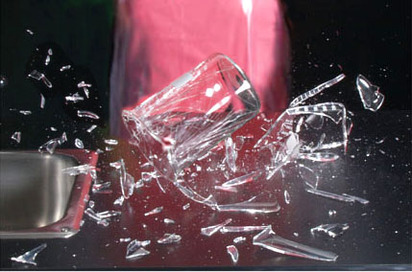
Chemical & Physical Changes - VISTA HEIGHTS 8TH GRADE SCIENCE
Lab: Physical and Chemical Changes Assignment: Reflect on ... Physical changes occur when the properties of a substance are retained and/or the materials can be recovered after the change. Chemical changes involve the formation of a new substance. Formation of a gas, solid, light, or heat are possible evidence of chemical change.
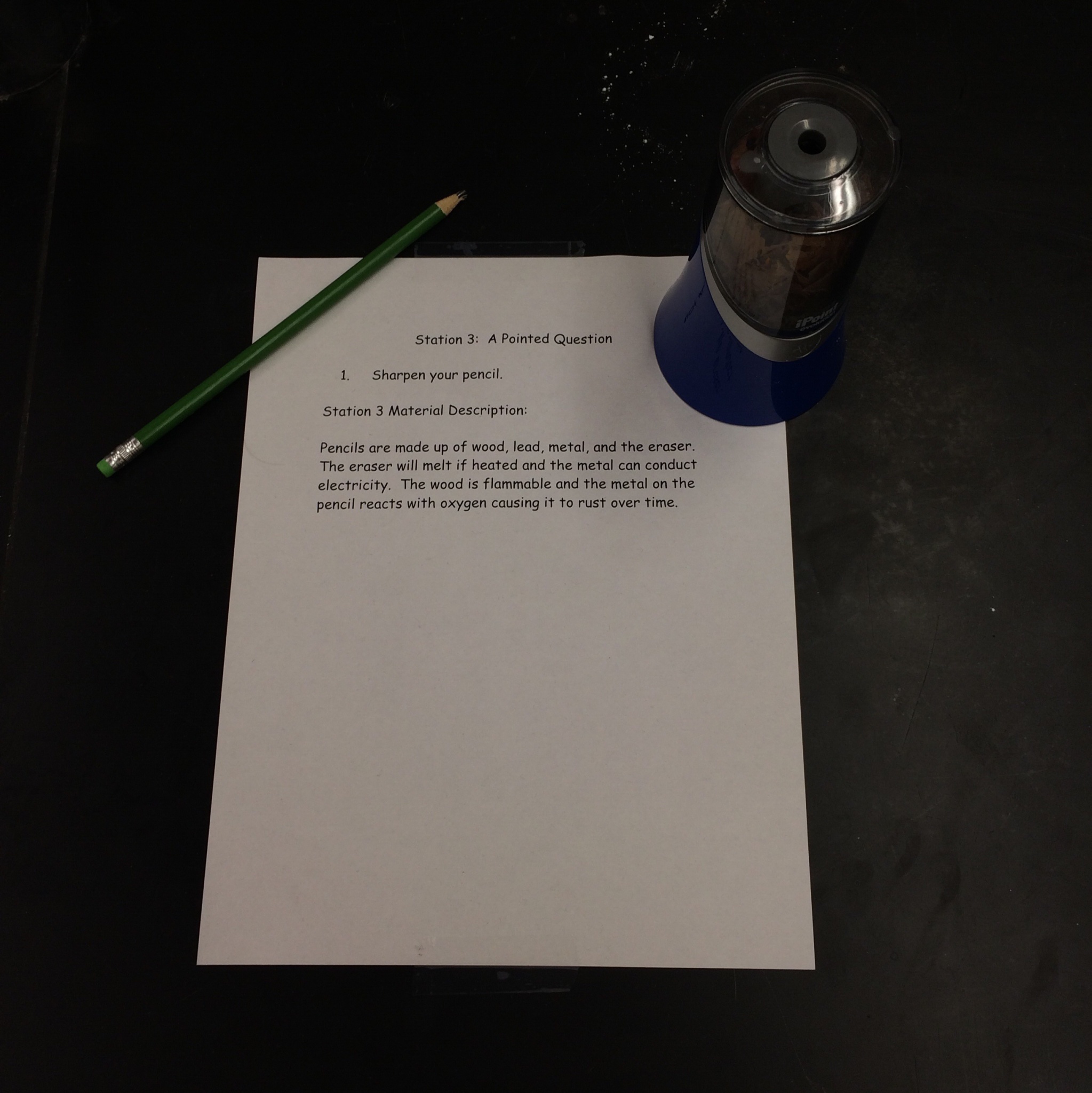
Lesson Chemical and Physical Changes Lab Stations ...
Five Physical and Chemical Changes Experiments - Teaching Muse Chemical and Physical Changes Experiment #3: Gas Balloons Another fun but easy experiment to use in your classroom involves soda and a balloon. Take a 1-liter bottle of any brand of soda and place a balloon around the mouth of the bottle. This experiment will need about ten minutes to see the changes.
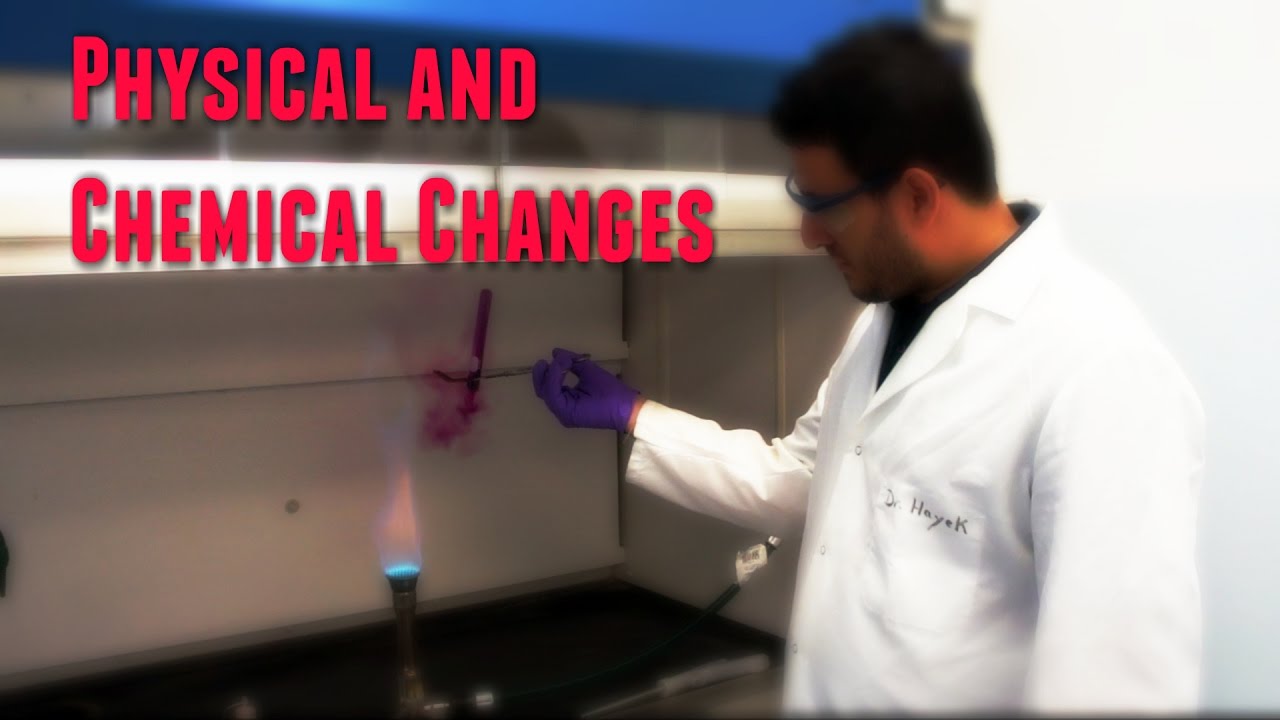
Lab Experiment #2: Physical & Chemical Changes. - YouTube
Chemical and Physical Changes Lab Write Up - CHM 121 ... Chemical and Physical Changes Lab Write Up lab 3 University College of Staten Island CUNY Course General Chemistry I Laboratory (CHM 121) Uploaded by Jenna Como Academic year 2021/2022 Helpful?10 Share Comments Please sign in or register to post comments. Students also viewed Lab #8 - Lab 8 Lab #5 Project 1 Lab Report - Grade: A
/123535121-58b5b3173df78cdcd8ac81de.jpg)
Examples of Chemical Reactions in Everyday Life
Physical Change vs Chemical Change Lab physical changes are: melting, freezing, condensing, breaking, crushing, cutting, dissolving, and bending. Chemical properties are determined by a reaction ...3 pages
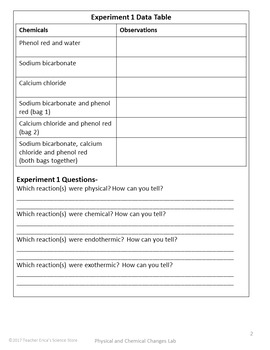
Physical and Chemical Changes Lab by Teacher Erica's ...
Chemical and Physical Changes Lab ⋆ iTeachly.com 3-1 Chemical and Physical Change - Lab Answers (Doc) Background Theory: Physical changes usually involve a compounds state of matter where heat energy is added or removed. For this reason, physical changes can be reversed. By contrast, chemical changes occur at the molecular level when two or more molecules are interacting.

Physical and Chemical Changes Lab_Station 5 - YouTube
Chemical and Physical Change Lab Activity - iTeachly.com Physical changes usually involve a change to a substances state of matter where heat energy is added or removed. The molecular structure of the substance remains the same. For this reason, physical changes can be reversed. Chemical changes, by contrast occur at the molecular level when two or more molecules are interacting.

Chemical and Physical Changes Lab Stations | Physical vs ...
Physical and Chemical Changes home lab copy.docx ... Physical and Chemical Changes Safety rules: Please wear goggles while doing the experiments below. Ingredients required for the experiments: Vinegar Baking soda Egg Cabbage juice Can of soda Copper pennies salt Procedure : Part I Opening a can of soda. Soda is a mixture of water and carbon dioxide. Open a can of soda and leave it open to the air. Write down your observation.
0 Response to "45 chemical and physical changes lab"
Post a Comment